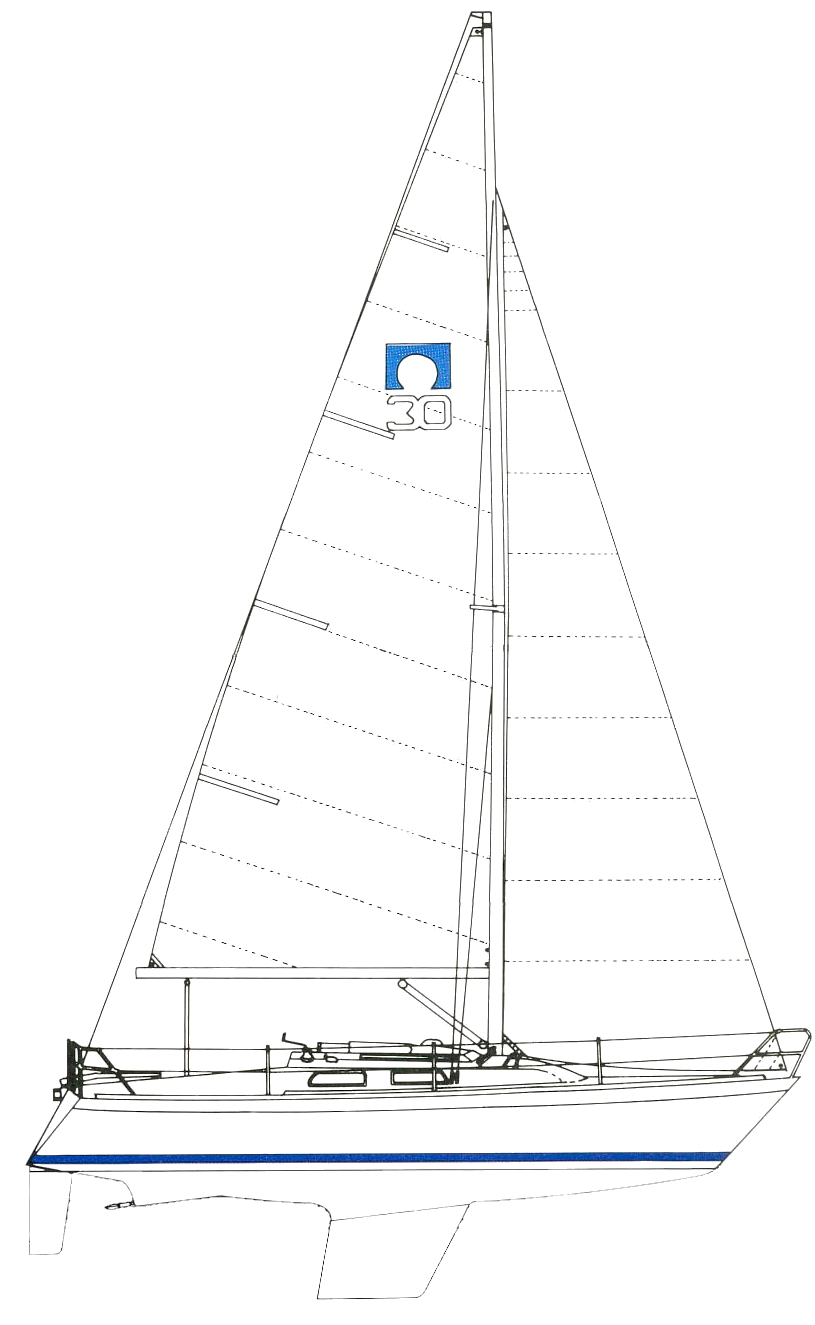
Side view
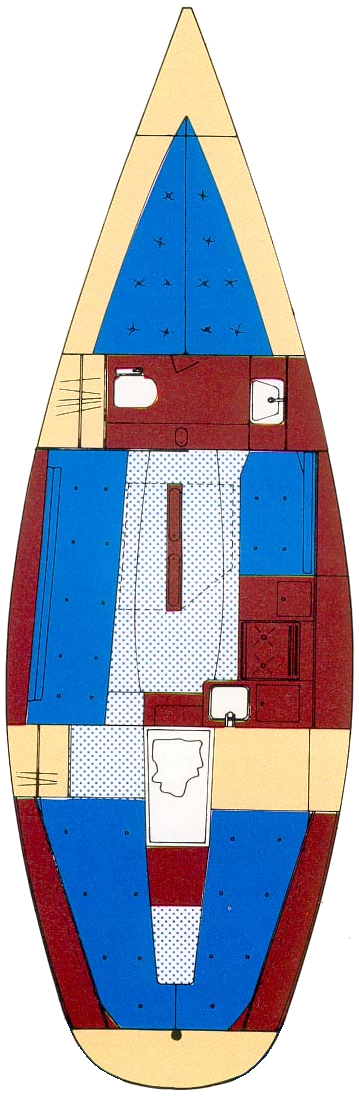
Layout Omega 30 A
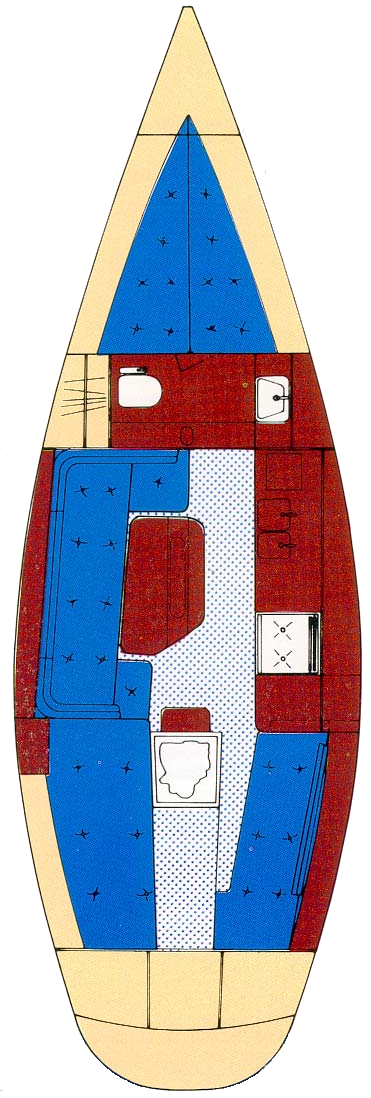
Layout Omega 30 S
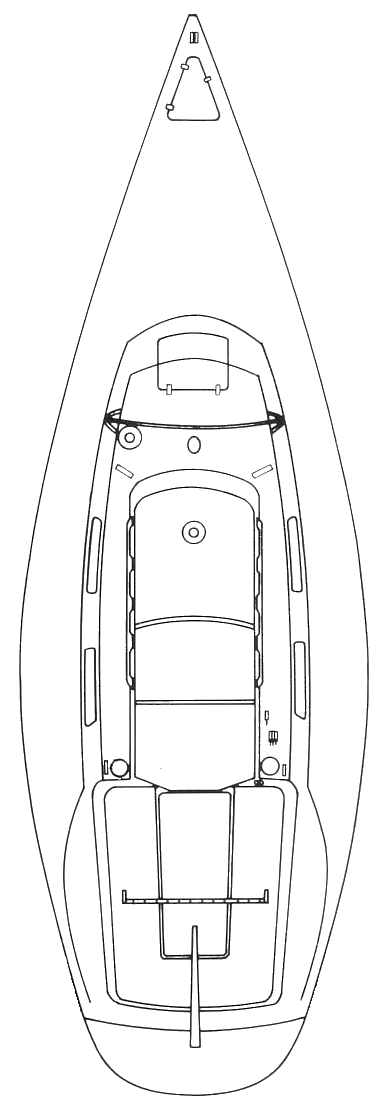
Deck Layout Omega 30 S
| Specification | Value | Comment |
|---|---|---|
| Years | 1983 – 1987 | Construction began in early 1982, sea trials were carried out in autumn that year. The 30 A was introduced to the market in spring 1983. The 30 S was introduced one year later in spring 1984. |
| Designer | Ron Holland | The Omega 34 and 36 were also designed by Ron Holland |
| Concept and idea | Rolf Gyhlenius | *1944 †2016 |
| Manufacturer | Svenska Familjebåtar AB | |
| Yard | Bröderna Börjesson /Örnsköldsvik Nötesund Varv AB / Vindövarvet | While Omega was a brand of the Svenska Familjebåtar AB company (in which Gyhlenius played a key role), the actual production of the boats was carried out by different yards. In the case of the Omega 30, early models were built in Örnsköldsvik, likely at the Bröderna Börjesson yard. Production was moved fairly early (around 1984?) to Nötesund Varv AB / Vindövarvet, which reportedly resulted in better overall build quality and a higher-quality wooden interior. I found no information on exact cutover dates or hull numbers. In addition, some boats were apparently sold as kits, with the interior to be built or installed by the owners themselves, which resulted in widely varying levels of craftsmanship and overall quality. |
| Quantity | ~ 300-320 | As of 2025, 63 boats have been registered with the Dansk Sejlunion. 10 Swedish boats had valid SRS certificates. |
| Length overall | 9.4 m (30.84 ft) | Sometimes also specified at 9.35 m |
| Length at waterline | 8.0 m (26.25 ft) | |
| Beam | 3.0 m (4.84 ft) | Sometimes also specified at 2.95 m |
| Draft | 1.55 m (5.08 ft) | |
| Construction weight | 3,150 kg | ORC certificates indicate actual displacement of 3,610 to 3,820 kg. The Dansk Sejlunion assumes 3,500 kg. |
| Keel weight | 1,130 kg | Iron keel with stainless steel bolts |
| Construction material | Polyester + Fiberglass | Deck built with a Divinycell foam core (“sandwich”). Wooden interior is mahogany with a matte finish. |
| Engine (standard) | Yanmar 1GM10 | By now oftentimes replaced with bigger engines like Yanmar 2GM20(F), 2YM15, Volvo Penta, Vetus or Lombardini. Reviews suggest that a stronger and/or fresh water cooled engine (2GM20(F)) could be ordered as an option. Some owners deem the original 1GM10 sufficient, but most suggest an upgrade. All boats came with a fixed shaft (25mm diameter) and a 2-blade folding propeller (which needs to be replaced when the engine is upgraded). |
| Sail areas | ||
| – Mainsail | 27 m² | ORC certificates indicate actual main sail areas of 26.51 to 29.35 m² |
| – Self-tacking Jib | 17 m² | ORC certificates show 16.58, 19.1, 20.76 and 27.33 m², which would make the larger ones not self-tacking jibs but genoas. |
| – Spinnaker | 65 m² | ORC certificates show 58.58 to 61.22 m² |
| – Reacher/Genoa 1 | 32 m² | |
| Water tank | 71 L | |
| Fuel tank | 25 L | 34 L tanks do exist at least for the S model |
| Wastewater tank (non-standard) | 29 L | |
| Mast length | 14.42 m | Supplied by Isomat Spars (NG-31 profile, some also report NG-28). Isomat went out of business in the mid-1990s. Spare parts are hard or impossible to come by, Rig-Rite Inc. (located in Warwick, Rhode Island, US) seems to be your best bet. The weld-on spreader bases are prone to failure and have reportedly resulted in multiple Omegas being dismasted. Check weld seams carefully and regularly! |
| Standing Headroom | 1.80 m | 1.80 m in the main cabin, 1.65 m in the wet room |
| Standard gelcoat | Plain white (e.g., Jotun G 200) | |
| Transport height (excluding cradle) | 3.25 m | |
| List price (1986) | SEK 292,000 DKK 360,000 | ~ SEK 764,000 (DKK 518,000 / €69,300) in 2025 adjusted for inflation and buying power. More data points (preferably invoices or price lists) would be appreciated. |
| Price (2025) | DKK 75,000 to 225,000 | ~€10,000 – 30,000 Very much depending on the overall condition of the boat and maintenance that has been carried out by previous owners as well as technical equipment. Most reasonably well-kept boats are in the DKK 110,000 – 150,000 (€15,000 – 20,000) range right now. |
Handicap and Rating Overview
| 🇩🇪 Yardstick (2025) | 102 | Source |
| 🇸🇪 SRS | 0.936 / 0.91 | with / without downwind sail – Source actual certificates show 0.915 – 0.934 / 0.88 – 0.911 |
| 🇸🇪 SRSs | 0.92 / 0.899 | with / without downwind sail (shorthanded) actual certificates show 0.902 – 0.919 / 0.817 – 0.899 |
| 🇸🇪 LYS | 1.14 | data as of 2003 (LYS was replaced by SRS since at least 2011) |
| 🇩🇰 DH TCC | 1.08 | May vary by actual measurement/certificate. Only one Omega 30 had a valid certificate in 2025 (Source). TCC = Time Correction Coefficient |
Links
- Active ORC Certificates for Omega 30 boats
- 🇸🇪 Issued SRS Certificates
- 🇩🇰 Dansk Seijlunion – Keel Boat Register
- 🇩🇪 Yardstick 2025
Polar Data
A polar diagram is a graph that shows how fast a specific boat can theoretically sail at different wind speeds and wind angles. It can be used to maximize boat speed and assist with route planning.
This Open Source project uses publicly available data from ORC certificates to plot polar charts and has data available for a total of 4 Omega 30s as well:
https://jieter.github.io/orc-data/site/index.html
I have averaged all available data into one plot that may serve as an approximation if you don’t have an ORC certificate for your boat.
Plot
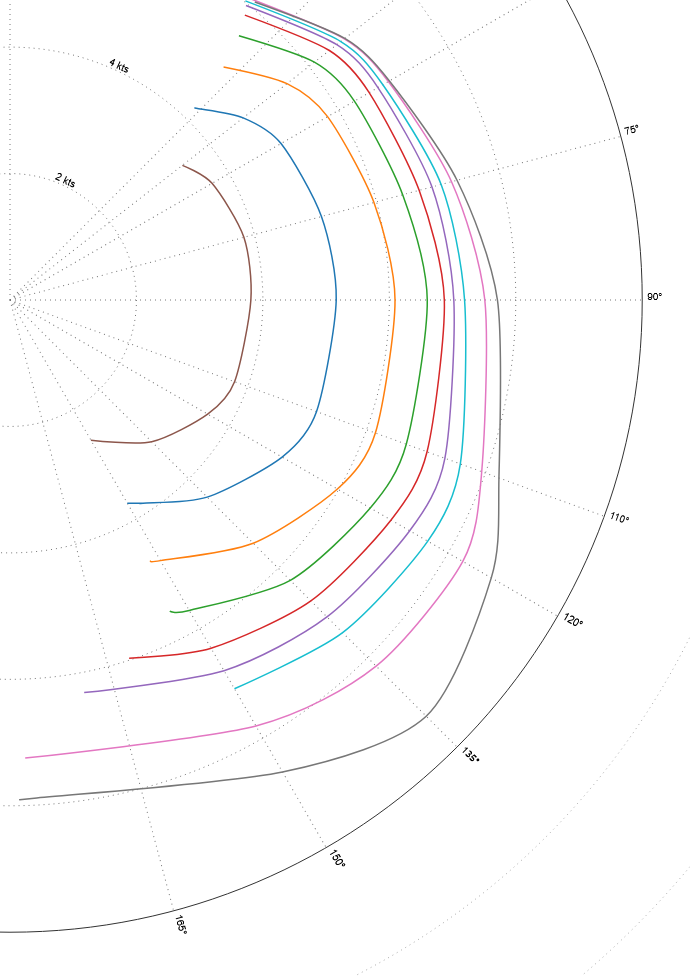

Raw Data (averaged)
twa/tws;4;6;8;10;12;14;16;20;24
44.4;3.08;0;0;0;0;0;0;0;0
44.4;0;4.24;0;0;0;0;0;0;0
42.5;0;0;5;0;0;0;0;0;0
40.9;0;0;0;5.53;0;0;0;0;0
39.5;0;0;0;0;5.84;0;0;0;0
38.7;0;0;0;0;0;5.97;0;0;0
38.2;0;0;0;0;0;0;6.02;0;0
38.4;0;0;0;0;0;0;0;6.09;0
39.4;0;0;0;0;0;0;0;0;6.1
52;3.46;4.68;5.56;6.11;6.41;6.56;6.64;6.71;6.72
60;3.69;4.95;5.8;6.29;6.56;6.72;6.81;6.91;6.93
75;3.83;5.1;5.96;6.43;6.7;6.91;7.06;7.23;7.32
90;3.81;5.16;6.09;6.6;6.87;7.02;7.19;7.51;7.71
110;3.78;5.16;6.15;6.67;7.02;7.32;7.58;7.94;8.23
120;3.61;4.97;5.98;6.58;6.96;7.3;7.63;8.27;8.79
135;3.17;4.41;5.44;6.27;6.73;7.09;7.44;8.19;9.31
150;2.56;3.71;4.76;5.67;6.36;6.77;7.1;7.78;8.62
146.8;2.65;0;0;0;0;0;0;0;0
146.8;0;3.84;0;0;0;0;0;0;0
151.6;0;0;4.69;0;0;0;0;0;0
152.8;0;0;0;5.53;0;0;0;0;0
161.6;0;0;0;0;5.97;0;0;0;0
169.3;0;0;0;0;0;6.32;0;0;0
177.2;0;0;0;0;0;0;6.62;0;0
178.1;0;0;0;0;0;0;0;7.25;0
177.2;0;0;0;0;0;0;0;0;7.89
Polar Table
| Wind velocity | 4kts | 6kts | 8kts | 10kts | 12kts | 14kts | 16kts | 20kts | 24kts |
| Beat angle (TWA) | 44.00° | 44.00° | 42.13° | 40.63° | 39.15° | 38.33° | 37.88° | 37.95° | 38.85° |
| Beat VMG | 2.21 | 3.05 | 3.71 | 4.19 | 4.52 | 4.68 | 4.76 | 4.80 | 4.75 |
| 52° | 3.46 | 4.68 | 5.56 | 6.11 | 6.41 | 6.56 | 6.64 | 6.71 | 6.72 |
| 60° | 3.69 | 4.95 | 5.80 | 6.29 | 6.56 | 6.72 | 6.81 | 6.91 | 6.93 |
| 75° | 3.83 | 5.10 | 5.96 | 6.43 | 6.70 | 6.91 | 7.06 | 7.23 | 7.32 |
| 90° | 3.81 | 5.16 | 6.09 | 6.60 | 6.87 | 7.02 | 7.19 | 7.51 | 7.71 |
| 110° | 3.78 | 5.16 | 6.15 | 6.67 | 7.02 | 7.32 | 7.58 | 7.94 | 8.23 |
| 120° | 3.61 | 4.97 | 5.98 | 6.58 | 6.96 | 7.30 | 7.63 | 8.27 | 8.79 |
| 135° | 3.17 | 4.41 | 5.44 | 6.27 | 6.73 | 7.09 | 7.44 | 8.19 | 9.31 |
| 150° | 2.56 | 3.71 | 4.76 | 5.67 | 6.36 | 6.77 | 7.10 | 7.78 | 8.62 |
| Run VMG | 2.22 | 3.21 | 4.13 | 4.93 | 5.67 | 6.21 | 6.61 | 7.25 | 7.88 |
| Run angle (TWA) | 146.83° | 146.83° | 151.60° | 153.08° | 161.70° | 169.10° | 177.20° | 178.10° | 177.73° |
- VMG stands for Velocity Made Good. It is the speed at which you are actually moving toward (or away from) your target, not just the speed of the boat through the water.
- Beat angle: The true-wind angle where the boat sails upwind at its fastest VMG.
- Beat VMG: The speed toward the upwind direction. It represents how fast you are making progress against the wind.
- Run angle: The true-wind angle where the boat sails downwind at its fastest VMG.
- Run VMG: The speed toward the downwind direction.